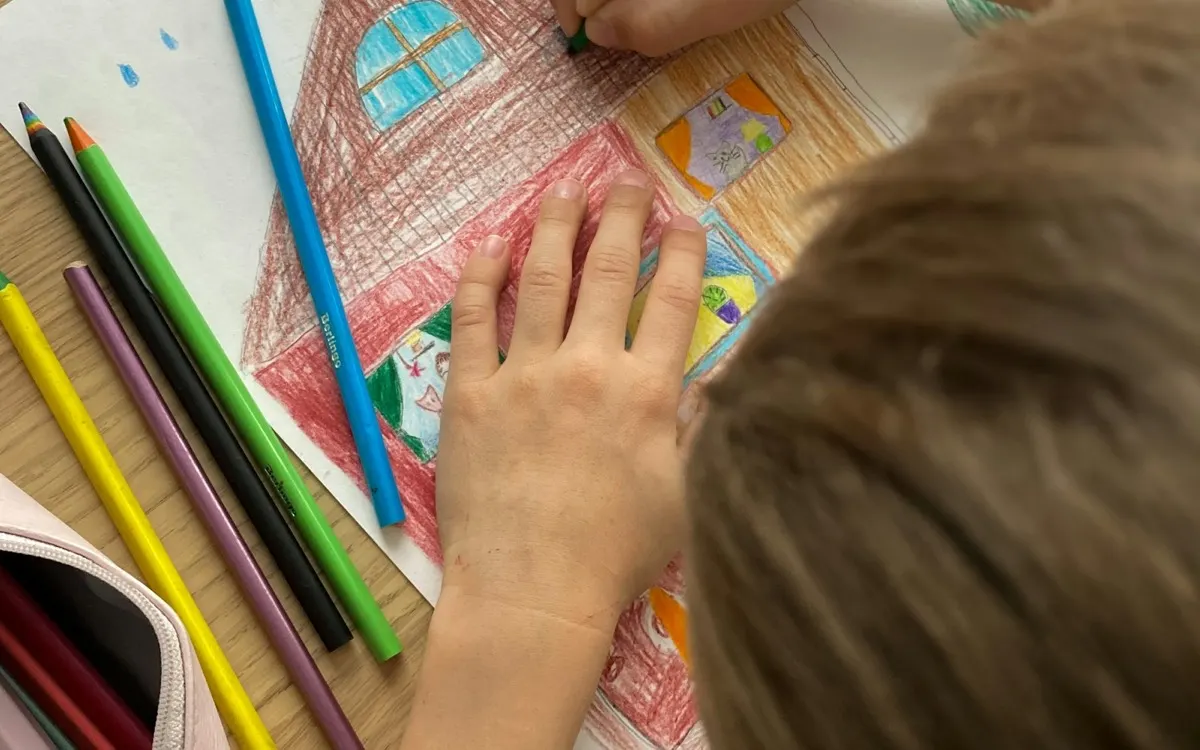
Material and scale
For creative exploration, offer a choice between pencil and crayon, a small sheet and a large one. A large collection is unnecessary: two options already allow preferences to emerge.
An introductory example
Try several lines on scrap paper: slow, broken and rounded. Choose one you want to continue. This is a creative experiment, not a personality test or treatment exercise.
Discussing the process
Ask yourself, “What felt easy?”, “Did I want a different tool?” or “What can remain unfinished?”. You do not need to invent psychological meaning when there is none for you.
Knowing when to stop
An ending can be practical: put down the pencil, clear the table and choose where to keep the work. If strong discomfort appears, do not force yourself to continue; discuss it with a practitioner.
Image and trace of movement
A drawing need not depict an object. It can remain the trace of a tool moving across a surface. Separate “what is pictured?” from “how did drawing happen?”. A person may be interested in either question, both or simply the material itself.
Empty space
Do not require the whole sheet to be filled. An unused area may be a compositional choice, a consequence of limited time or an accidental decision. Do not label it avoidance or low energy. If discussion is wanted, ask whether the creator considers the work finished.
Corrections and new versions
At home, try an eraser, a fresh sheet or drawing over an old line. Each offers a practical difference. Do not turn the choice into a test of personality flexibility: wanting to erase a line may mean only wanting to erase a line.
Comparison without competition
If keeping a series, label dates and materials and optionally add a personal note. Review it as a record of experiments. More colours or a detailed scene do not automatically indicate psychological progress; changes in everyday life need separate discussion.
Movement, form and symbol: three ways of looking
The Expressive Therapies Continuum distinguishes kinesthetic/sensory, perceptual/affective and cognitive/symbolic levels. It is a theoretical map, not a home neuropsychological test. Consider three questions about a drawing: how did the hand move, how are the visible forms organised and what meaning does the creator give the image? A wavy line might be an interesting movement, part of a pattern or a river in an invented story. There need not be only one answer. The distinction helps avoid reducing the whole process to subject matter or inferring brain activity from the appearance of a line.
Observation through a simple example
Imagine drawing a houseplant. You might attend to a leaf's outline, alternating light and dark areas or the rhythm of repeated forms. These are different artistic tasks although the subject is unchanged. Afterwards, ask what caught your attention. The answer describes today's specific drawing experience. It does not establish a permanent personality type or make one way of seeing psychologically superior. This example explains a choice of attention: before asking about emotions, it is possible simply to describe what someone actually did and noticed. A precise description provides a starting point without requiring a hidden story.
What a study says versus a headline
A small study of 39 healthy adults found lower average cortisol after 45 minutes of visual art making. There was no control group, limiting causal conclusions, and the activities were not confined to drawing. This does not prescribe exactly 45 minutes, create a stress test or guarantee treatment. It illustrates how to read “art reduces stress”: return to who participated, what was measured and what comparison was made. You can notice a personal sense of calm too, but that is not identical to a laboratory measure and does not need an artificial numerical confirmation.
From a page to conversation
Possible starting points include a title, one detail, the order of making or the moment you wanted to stop. The most private topic need not come first. In an invented example, the creator says, “I left the middle empty because I could not decide where the plant should go”. A practitioner can clarify that decision before searching for a metaphor about emptiness. If the creator connects it to another situation, that connection can be discussed as their own idea. Continue with “Why a drawing is not a diagnosis” and “Approaches: process, image and conversation” for the next conceptual steps.
Theme, format and freedom
The theme, paper size and way of working can be chosen independently. “A garden” might use a small or large page, colour or monochrome, a provided outline or a free composition. If many conditions change together, it becomes harder to notice what altered the experience. For ordinary exploration, compare two options while keeping other conditions similar. This is a way of learning about materials, not measuring personality. In therapy, suitability is discussed separately; a list of drawing themes is not a complete care programme.