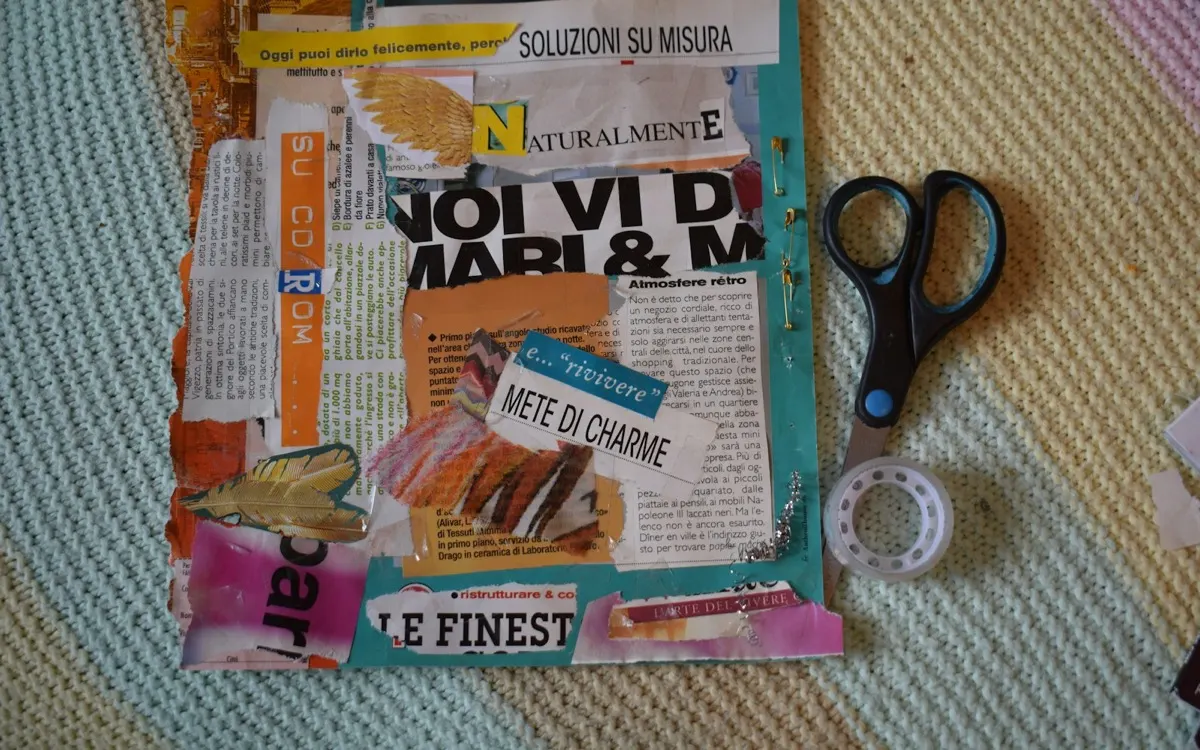
Why existing fragments?
Collage works with colours, words and images that already exist. For home creativity, try your own photographs, paper offcuts or packaging without sharp edges.
Try without glue
Arrange a few fragments before sticking them down. Explore a different order, wider gaps or an empty centre. There is no required composition or correct choice.
Who owns the meaning?
If you want to discuss the collage, begin with what you chose to include. An image has no fixed psychological meaning; one photograph can evoke different associations.
Photographic privacy
Before using family photographs, consider who will see the result. Do not publish images of others without permission. For an open workshop, impersonal fragments may be easier to use.
Choosing also creates an image
Authorship in collage is not limited to making every piece from scratch. Selection, scale, proximity and order shape the composition. These offer concrete things to discuss: which element became central, what was removed and what remained undecided.
Words as materials
Use individual words without having to make a slogan or positive affirmation. Pair a word with a colour or put it on the back. Do not demand an optimistic message: a creative idea does not have to demonstrate a correct attitude toward life.
Two arrangements
One simple format is a grid of separate fragments; another uses overlapping layers. Compare which feels more workable today. This is a compositional choice, not evidence that one creator is controlled and another chaotic. Preferences can change.
Public and private versions
You may want to keep personal words private while showing a coloured section. Make a separate version for sharing or choose not to share. Privacy need not be sacrificed for a finished result, group discussion or attractive workshop photograph.
Montage creates new relationships
Collage works through relationships between fragments as well as the meanings of individual images. Imagine a tree cutout and the word “pause”. Together they might suggest rest to the creator; far apart they might simply remain two details. This is not a universal formula: meaning emerges within a particular work and its creator's explanation. Distinguish a fragment's source from its new composition. An advertising photograph may originally sell a product, yet become a patch of colour, part of an imaginary city or something else. Its original purpose does not determine every subsequent use or association.
Reversible choices and permanent glue
Before gluing, pieces can move easily. Afterwards, changing the work may involve adding a layer, cutting something out or starting another version. These ordinary properties of the technique are worth explaining beforehand. In an educational example, someone tries three layouts and photographs them privately for comparison. They then choose one or leave all unfinished. The decision has clear practical consequences. Delaying the glue does not automatically mean fear of commitment, and gluing quickly does not establish impulsiveness. Such interpretations would add a conclusion that the creator has not made to what may be an ordinary material decision.
A research example: autonomy
A qualitative collage study interviewed five women receiving inpatient cancer treatment; they described positive experiences and a stronger sense of autonomy. This small experience-focused study does not demonstrate a universal treatment effect. For educational discussion, autonomy can be considered through choices: selecting a fragment, deciding its place and agreeing or declining to discuss it. Our practical interpretation should not reduce autonomy to cutting independently. Someone may need physical assistance while remaining the author of every decision. Help with scissors and authority over meaning are separate matters that can be negotiated separately.
The image collection shapes the choices
If all available magazines show the same age, family structure, appearance or lifestyle, choices are restricted before work begins. An open workshop can include neutral textures, abstract papers and the option to draw an original detail. Participants need not find themselves in a prefabricated image collection. They can avoid pictures of people or use only colours. This is a practical example of how preparing materials relates to accessibility. Continue with the articles on materials, the creator's meaning and confidentiality to organise collage as a clear process of choice, rather than as a collection of images someone else has already interpreted.
From selection to composition
Distinguish collecting materials, arranging them and joining them. An interesting fragment need not have a place immediately. Arrangement gives it neighbours, scale and direction; joining preserves chosen relationships. These steps may repeat and overlap rather than follow a rigid sequence. A newly found fragment can change an almost finished composition. This description supports discussion of observable decisions instead of guesses about inner states. If help is requested, clarify whether the person wants more materials, a technical action or simply time to choose.