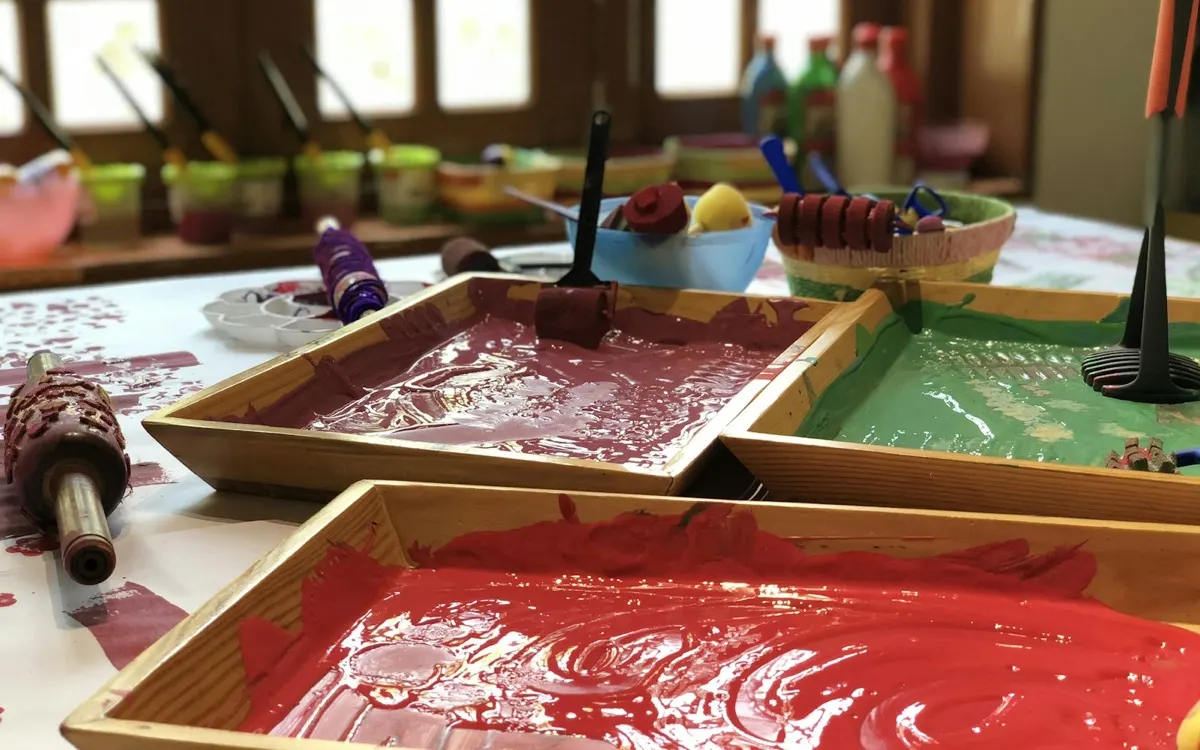
Materials create possibilities, not predetermined outcomes
Paint does not guarantee emotional release, and clay does not automatically suit every anxious person. Materials differ in how they respond, how much preparation they require and how they feel in the hands. Choices depend on purpose, accessibility and personal preference. Someone who enjoys precision may feel comfortable with a pencil; another person may enjoy a flowing patch of colour. These are possible preferences, not psychological types. In professional work, the practitioner selects materials with the participant. At home, exploring what feels enjoyable does not require attaching a hidden meaning to every choice.
Dry materials: control, portability and simple variations
Pencils, wax crayons and felt pens are practical when preparation time is limited. Pencil pressure can vary, but a thin barrel is not comfortable for everyone. A broad crayon may suit larger movements; check with the individual. Compare short lines on one sheet with broad marks made using a crayon’s side on another. Asking which feels easier is more useful than drawing conclusions about personality. Permanent markers and professional artists’ products should not automatically enter a children’s kit. Intended use, instructions and the setting matter more than the fact that a product makes an appealing mark.
Paint: more variables and more preparation
Fluid materials introduce mixing, watery marks, unexpected transitions and drying time. One person may enjoy this; another may dislike the unpredictability. Two colours and one brush can be enough to explore the material without too many decisions. Position water securely, leave space for a wet sheet and plan cleaning before starting. Do not insist on touching paint directly when a brush or another option is available. Avoiding messy hands is not proof of a psychological difficulty. Children need paint intended for their age and the planned use, rather than whatever happens to be in an adult’s studio.
Collage: ready-made images and personal arrangements
Collage can help when a blank page feels daunting or someone does not want to draw. Materials might include coloured paper, personal photographs or images you have permission to use. Ready-made pictures also shape the choices available: a selection containing only smiling faces already narrows possibilities. Include abstract shapes and blank cards that may remain blank. Let participants rearrange pieces before attaching them. A family activity does not need a correct composition. If work will be published, separately check consent from people pictured and rights for any borrowed illustrations.
Three-dimensional materials: form, effort and care
Modelling material, paper structures and wooden pieces offer different ways to change space. For comparison, participants could make a support for a cardboard flag using paper or suitable modelling material. Conversation can focus on stability and convenience, rather than symbolic strength of personality. Consider ingredients, allergies and care and storage instructions. Homemade does not automatically mean safe, and natural does not mean edible. Check wooden surfaces, attachments and dimensions. Professional ceramics involving dust, glazes and firing require appropriate facilities; they do not belong in an improvised activity at a young child’s table.
Safety means checking the specific product
The CPSC guide addresses art-material hazards and suitable labelling; American markings do not replace requirements in the country of use. Keep original packaging and instructions, particularly when transferring supplies to another container. Non-toxic does not mean edible or suitable for application to skin. Separately consider small components, sharp tools and access by younger children. Poison Control highlights the particular hazards of swallowing magnets and batteries: these should not appear in an improvised craft kit. Suspected dangerous ingestion needs urgent medical attention, rather than waiting for an activity to finish.
Accessibility and a small starter kit
A starting collection can contain different paper sizes, a few comfortable drawing tools and one familiar alternative. Expensive kits are not a prerequisite for meaningful creativity. Consider table height, lighting, keeping paper steady and whether the person can reach materials independently. A large format suits some people; others prefer a smaller, bounded area. Avoid describing adaptations as easier options for weaker participants: they make participation possible. Pain or rapid exhaustion during a familiar action needs individual advice, rather than instructions to practise longer. Accessibility also includes cost, available space and the time required for cleaning.
Choosing purchases without therapeutic marketing
Before buying, answer four questions: what will people actually do with this, who can use it comfortably, what safety limits apply, and where will it be stored? Compare specifications rather than promises of harmony. For wooden sets, exact dimensions and a finish description help; for printed materials, consider format, contrast and cutting requirements. No product is art therapy on its own. In a professional setting, materials belong to a wider process; at home, they offer possibilities for play. The best choice may already be available, provided it is safe, accessible and interesting to the participant.